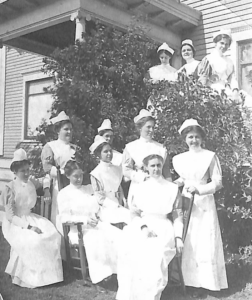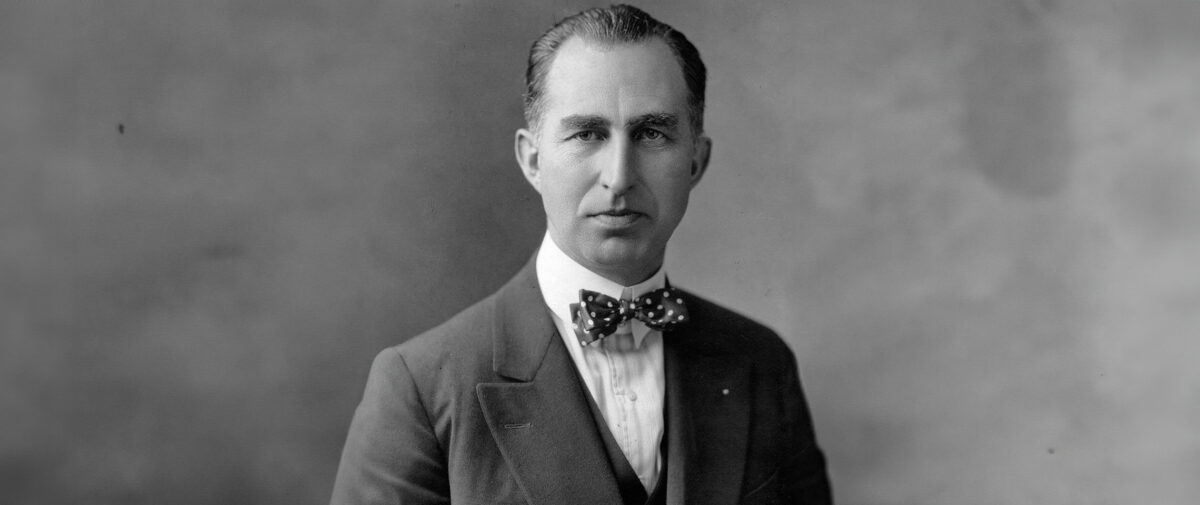
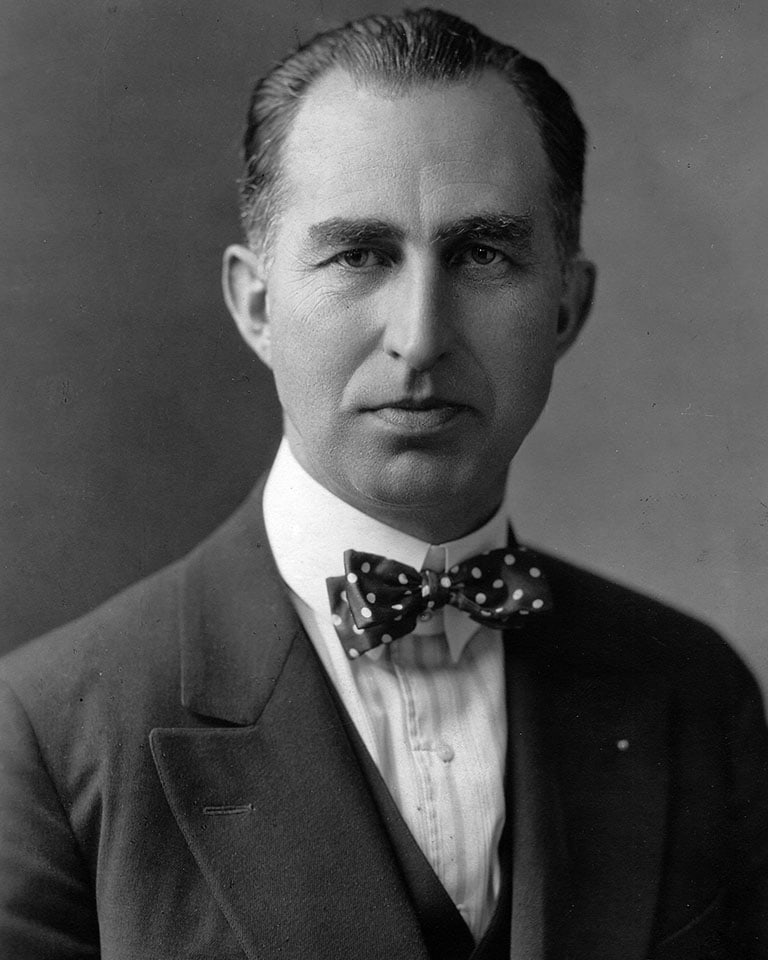
Few people have had such a great impact on the Boston sports scene as Charles F. Adams (1876-1947). A Vermont transplant who made his home in Framingham, Adams brought the Bruins to Boston, was a major contributor to the construction of the Boston Garden, led the effort to build Suffolk Downs, and for several years was a minority owner of the Boston Braves. All of this was accomplished while he was the treasurer, director, and eventually chairman of the board of the First National chain of grocery stores.
On October 18, 1876, Frank and Elizabeth Adams welcomed their first child, Charles Francis into the world. The family of modest means made their home in the Northeast Kingdom town of Newport, Vermont. Over the next eight years, the couple had three more children; Abel Vernon (1878-1968), R. Glen (1882-1887) and Josephine E. (1884-1942) (Memorial). After completing the first twelve years of his education in the Newport Public Schools, Charles went on to study at Jenney Business College in Enosburg, Vermont (“Charles Francis…”).
It was in Newport that Charles began his lifelong association with the grocery business. As a youngster, he went to work at the corner grocery store doing odd jobs. After his college graduation, his uncle, Oscar Adams, hired him to be a salesman for his wholesale grocery business called Smith and Adams. Charles traveled up and down the East coast from New England to Virginia and as far west as Chicago selling maple syrup, tobacco, and other New England products (LeMoine 153). He met his future wife, Lillias Mae Woollard, on a sales call in Vermont. Lillias was visiting her sister when Adams stopped by the store to pedal his maple syrup. The couple married in 1901 in Windham County Vermont, and settled in Springfield, Massachusetts, where their only child, Weston, was born in 1904 (LeMoine 153).
Charles’ next career move was to manage the Vermont Farmer’s Co. for his uncle. He then served as treasurer of the New England Maple Syrup Company which necessitated the family’s move to Cambridge, Massachusetts. When these two companies merged in 1906, he stepped away from the wholesale food business and tried his hand at investment banking. It was while at Fitzgerald, Hubbard & Co., a banking and brokerage house in Boston, that he met John T. Connor, a grocery magnate. Charles could not persuade Connor to purchase any of his financial products, but Connor did convince Charles to invest in his company. Eventually, Connor hired Charles. In 1914, Charles bought Connor’s company and its one hundred twenty four Brookside Stores.
As the company’s president, Charles began an aggressive expansion program adding eighty six stores by 1919, one hundred forty more by 1923, and two hundred fifty more by the late 1925 bringing the total number of Brookside Stores to six hundred. It was in 1925, that the John T. Connor Company and two rival grocery store chains, O’Keeffe, Inc. and The Ginter Co., merged to create First National Stores, Inc. At the time, this new company had over one thousand five hundred stores throughout New England. All the existing stores would continue to operate under their old names and any new ones would be called First National Stores (Stock).
The officers of the new company were M. O’Keeffe, president, A. F. Goodwin of the Ginter Co., chairman of the board, and Charles F. Adams, treasurer (Merger).
Boston Bruins
While Charles was building his grocery store chain into one of the largest in the country, he was at work transforming the Boston sports scene. Having grown up in northern Vermont, he had a lifelong love of ice hockey. At the time, there was only amateur hockey to watch in the United States. One had to travel north to Canada to watch the professionals play.
Attendance and interest in amateur hockey dropped in Boston after a scandal occurred between the Pittsburgh Yellow Jackets and the Boston AA. The Pittsburg Team threw a home playoff game to secure another home game at Duquesne Gardens. The controversy prompted Charles to decide that the time was right to bring a professional hockey team to Boston.
November 1, 1924 was a memorable day in Boston sporting history. That was the day Charles received his NHL franchise (“Charles”). The first game for the new Bruins was played in December of that same year. The Bruins’ loss that day was the start of a two year losing streak.
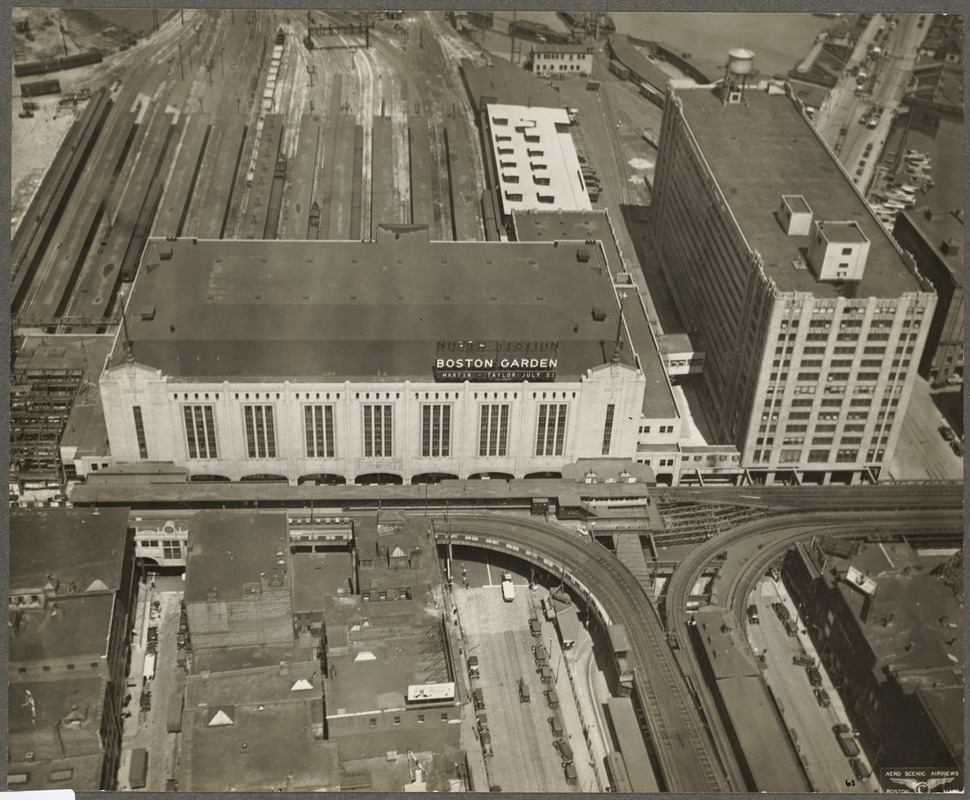
Charles sought to change the team’s fortunes, by buying up the entire Western Canada League (“Charles”). In the deal, he secured such hockey greats as Eddie Shore, Harry Oliver, Duke Keats and Frank Bouche for his Bruins (“Charles”). Charles also lost money that first year due to the small crowds at the games. Through a stroke of genius, he built a fan base by broadcasting the hockey games on WBZ radio. Next on Charles’ agenda was to build a first class venue for his team. He put up half a million dollars for the construction of the Boston Garden which opened its doors in 1927. All of these changes had the desired effect as the Bruins went on to win the Stanley Cup in 1929.
Boston Braves
Charles became a minority owner of the Boston Brave baseball team in May 1927. He was part of a small group of businessmen which bought Albert H. Powell’s shares in the ball club. Charles was elected vice president of the club and served on its board of directors until 1935. At that time, due to his ownership in Suffolk Downs, Baseball Commissioner Kenesaw Mountain Landis requested Charles sell his shares in the ball club (Johnson).
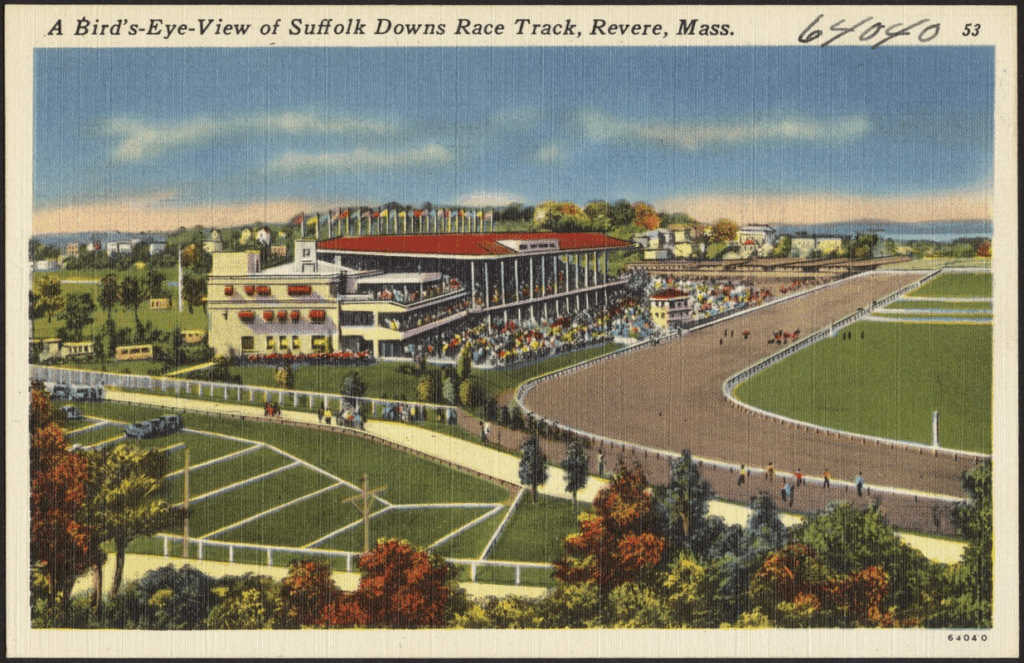
Suffolk Downs
Charles’ interest in sports did not begin and end with ice hockey and baseball. He was also a horseman. On May 1, 1922, he bought the 200 acre Wedgemere Farm at the corner of Salem End and Badger Roads In Framingham. There, he and Lillias raised thoroughbred trotters. Charles served as president of the Meadow Brook Club of Framingham, a club for horse enthusiasts. Charles and his neighbor, John R. Macomber, another horseman, were part of the syndicate called The Eastern Racing Association which was instrumental in the building of Suffolk Downs in East Boston. Through their efforts, Suffolk Downs opened for racing on July 10, 1935. Charles served as President of the race track from 1936-1937 and then again from 1939-1944.

Around the time Charles turned 60 years old, he began to suffer from a series of illnesses. This led to his decision to retire from his position at First National Stores (C.F. …Leader). In 1936 he transferred his ownership in the Bruins to his son, Weston, and in 1945, sold his interest in Suffolk Downs to Alldred Investment Trust for four million dollars. Poor health continued to plague him, and while on a fishing trip with friends in northern Maine in late September 1947, Adams fell ill. He was flown to Boston for treatment at Massachusetts General Hospital. Charles passed away on October 2, 1947 at MGH’s Phillips House. After a private funeral at the Waterman Funeral Chapel in Boston officiated by the Rev. John Ogden of the First Parish, Unitarian Church in Framingham, Adams was interred in Edgell Grove Cemetery.
Did You Know?
- Adams was elected to the Hockey Hall of Fame in 1960.
- Adams paid $15,000 for his NHL franchise
- The original colors of the Bruins were brown and gold to match the colors of the trim on Adams’ Brookside grocery stores.
- In 1974 the NHL named one of its four new divisions after the Adams Family ( Charles, his son Weston, and his grandson Weston Jr.): The Adams Division.
- Weston Woollard Adams, Sr. was elected to the Hockey Hall of Fame in 1972.
- Lillias Adams sold Wedgemere Estate to the Massachusetts Congregational Conference and Missionary Society in 1950.
- Lilias Woollard was born in Grenville, Ontario, Canada.
- Adams was a founder and director of Framingham Trust Company.
- Wedgemere Farm consisted of a twenty room colonial, a twelve room farmhouse, and several other buildings (“Complete”).
Bibliography
Aero Scenic Airviews Co. (Boston, Mass.). Boston Gardens, North Station. From 800
feet. 1929. Web. 15 Sep 2024. <https://ark.digitalcommonwealth.org/ark:/50959/9593vd276>.
A bird’s-eye-view of Suffolk Downs Race Track, Revere, Mass.. Tichnor Bros. Inc.,
Boston, Mass., 1930. Web. 15 Sep 2024. <https://ark.digitalcommonwealth.org/ark:/50959/1z40kt539>.
“C. F. Adams, Business and Sports Leader, Dead.” Boston Globe 2 Oct. 1947, pp. 1+
Newspapers.com by Ancestry.
https://www.newspapers.com/article/the-boston-globe-charles-adams2/154715463
“C. F. ADAMS PRESIDENT OF EASTERN RACING BODY.” Daily Boston Globe
(1928-1960), May 08, 1936, pp. 30. ProQuest,
“Charles Adams.” Official Site of the Hockey Hall of Fame.
”https://www.hhof.com/HonouredMembers/MemberDetails.html?type=Builder&mem=B196001&list=ByName
“Charles Francis Adams.” Vermont’s Northland Journal. 10 Sept. 2005.
https://web.archive.org/web/20050910173636/http://www.northlandjournal.com/stories1.html Accessed 2 January 2024.
“Complete transfer of Wedgemere FArm Estate as Conference Center.” Framingham News 5
July 1950.
Doherty, Bob (Monty). “The Somerville Times Historical Fact of the week – January 22.” The
Somerville Times, Jan. 22, 2014. https://www.thesomervilletimes.com/archives/46039
Accessed 31 Dec. 2023.
“FIRST NATIONAL STORES’ BIRTHDAY: HAS SERVED NEW ENGLAND CONSUMERS 10 YEARS.” Daily Boston Globe (1928-1960), Apr 30, 1935, pp. 12. ProQuest,
https://ezproxy.bpl.org/login?url=https://www.proquest.com/historical- /first-national-stores-birthday/docview/758570671/se-2. Accessed 24 Dec. 2023.
Johnson, Richard A. “Charles F. Adams”. The Sports Museum.
https://www.sportsmuseum.org/curators-corner/charles-f-adams/ Accessed 31 Dec.
2023.
LeMoine, Bob. When the Babe Went Back to Boston.
Jefferson , NC : MacFarland & Co., 2023.
“ Memorial page for Charles Francis Adams (18 Oct 1876–2 Oct 1947)” Find a Grave
Memorial ID 96097583 Find a Grave.
(https://www.findagrave.com/memorial/96097583/charles-francis-adams: Accessed 31 December 2023),
“MERGER AGREEMENT BY CHAIN STORE FIRMS: O’KEEFFE’S, INC, JOHN T. CONNOR
CO AND GINTER CO TO BE FIRST NATIONAL STORES, INC.” Boston Daily Globe (1923-1927), Nov 20, 1925, pp. 1. ProQuest, https://ezproxy.bpl.org/login?url=https://www.proquest.com/historical-newspapers/merger-agreement-chain-store-firms/docview/498645042/se-2.
O’Leary, James. “BOSON MEN BUY SHARE IN BRAVES: CHARLES F. ADAMS IS
ELECTED VICE PRESIDENT OF CLUB HOCKEY MAGNATE, WETMORE AND
FARNSWORTH GET STOCK.” Boston Daily Globe (1923-1927), May 16, 1927, pp. 1. ProQuest, https://ezproxy.bpl.org/login?url=https://www.proquest.com/historical-newspapers/boson-men-buy-share-braves/docview/251064100/se-2.
“STOCK DIVIDEND FOR GINTER STOCKHOLDERS.” Boston Daily Globe
(1923-1927), Dec 07, 1925, pp. 17. ProQuest,
https://ezproxy.bpl.org/login?url=https://www.proquest.com/historical-newspapers/stock-dividend-ginter-stockholders/docview/498691349/se-2.
“STORE MERGER HAS $5,000,000 CAPITAL: FIRST NATIONAL STORES, INC, IS
NAME CHOSEN M. O’KEEFE TO BE PRESIDENT OF THE NEW CONCERN.” Boston Daily Globe (1923-1927), Nov 21, 1925, pp. 2. ProQuest, https://ezproxy.bpl.org/login?url=https://www.proquest.com/historical-newspapers/store-merger-has-5-000-capital/docview/498644473/se-2.
“TODAY in Masonic History: Charles Francis Adams is born” Masonrytoday.com
http://www.masonrytoday.com/index.php?new_month=10&new_day=18&new_year=2014 Accessed 10 Feb. 2023.